
When pain, swelling, or stiffness shows up after an injury or workout, guessing at the cause can waste time and delay real relief. Diagnostic ultrasound uses sound waves to create a real-time picture of your tendons, ligaments, and muscles, giving your provider a clear view of what is actually happening inside the joint or soft tissue without exposing you to any radiation.
At Modern Edge Sports & Orthopedic Medicine, Dr. Michael Wong, DO, personally performs diagnostic ultrasound imaging and ultrasound-guided injections for every patient who needs them. He combines this hands-on imaging with his sports medicine training from UPMC to pinpoint the source of your pain and build a treatment plan around it.
If you are dealing with pain that has not been fully explained, request an appointment to see how diagnostic ultrasound can help clarify your diagnosis and your next steps.
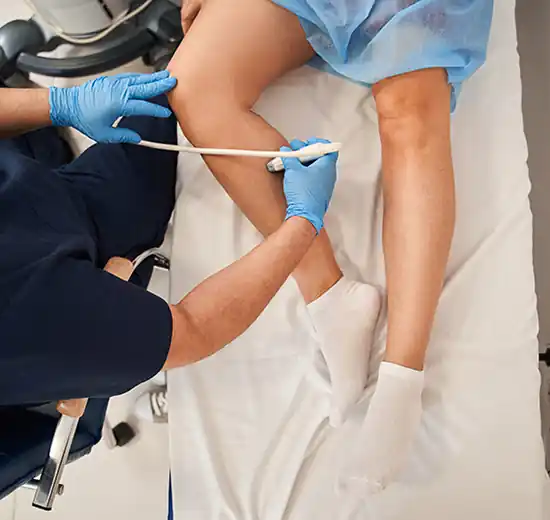
Diagnostic ultrasound sends painless, high-frequency sound waves into the body and translates the echoes into a live image on a screen. Because the image updates in real time, our team can watch a tendon or joint move as you flex, rotate, or bear weight, which is something static imaging cannot show. This makes it especially useful for sports injury and joint pain evaluations when the exact source of discomfort is not obvious from a physical exam alone.
Sprains, strains, tendinitis, and bursitis all involve soft tissue that standard X-rays cannot see clearly, since X-rays are designed to show bone. Diagnostic ultrasound fills that gap by giving a detailed look at tendons, ligaments, muscles, and the fluid-filled sacs called bursae that cushion your joints, helping confirm exactly which tissue is involved before we recommend treatment.
Beyond diagnosis, ultrasound plays an important role in treatment. Dr. Mike uses real-time ultrasound guidance to place injections, including PRP injections and corticosteroid injections, with greater precision than a guess-and-check approach allows. Watching the needle and the target tissue on screen at the same time helps ensure the medication or treatment reaches the intended spot.
Diagnostic ultrasound, magnetic resonance imaging (MRI), and X-ray each serve a different purpose, and one does not replace the others for every situation. Ultrasound offers real-time, radiation-free imaging that is well suited to soft tissue and to watching how a joint moves, and results are often available the same day, right in the office. MRI provides a more detailed, static view of deeper structures like ligaments deep inside a joint or cartilage, which can be useful when a more complete picture is needed, and X-ray remains the standard for evaluating bone and detecting fractures.
Dr. Mike will recommend the imaging, or combination of imaging, that fits your specific symptoms rather than relying on a single tool for every case.
Sports medicine ultrasound is used to evaluate soft tissue injuries like sprains, strains, and tendon irritation, and to guide injections with greater accuracy. It gives a real-time view of how a joint or muscle moves, which is useful for injuries that only cause symptoms with certain motions.
Yes. Dr. Mike personally performs diagnostic ultrasound imaging and ultrasound-guided injections as an ultrasound imaging specialist for every patient who needs them, rather than referring that portion of care out to a separate imaging center.
Ultrasound for joint pain evaluation can help identify inflammation, fluid buildup, or soft tissue changes contributing to your discomfort. Once we understand the cause, we can discuss non-surgical options, which may include guided injections or a structured rehab plan, based on what the imaging shows.
Scheduling with our team is easy and works around your calendar, whether you visit us in Harrison City, Wexford, or Shadyside. You can request an appointment online at any time, and our care coordination team will follow up to confirm your visit. Take the first step toward getting real answers about your pain and request your appointment today. We look forward to seeing you.